Wednesday, August 18, 2010

Medina to Madison Park in an hour or so

They piled onto the Madison Park shore this morning in five separate waves. Swimmers (306 of them) and kayakers (80 of them), all having plowed across Lake Washington to benefit a very good cause. It was by far the biggest Swim for Life in the 13 year history of the event, which raises funds for the Puget Sound Blood Center (PSBC). Last year there were only 250 or so participants, and it was not that long ago (perhaps two years) that there were only about 30 swimmers making the race.

So Swim for Life, the brainchild of banker Scott Leopold, has come a long way since 1998 when, according to PSBC President James AuBuchon, Leopold did the very first Swim for Life solo.
.
The weather didn’t quite cooperate, making the course choppy (“wicked fierce” said one participant); and the air temperature was a bit bracing for the swimmers when they arrived on the beach after their 2.25- mile workout. But shivering or not (and most were not), everyone seemed to be having a good time, spectators included.

For reasons of safety, a kayaker was a part of each of the 80 teams participating. With a maximum of four swimmers per team, the kayakers were able to effectively monitor the progress of each of the team's swimmers as they navigated the straight-line course to Madison Park.

Swim for Life this year was successful in raising almost $50,000 as of the start of the race. And it’s not too late to donate, so click here to do so. All funds raised from the event this year will go to fund registration fees for the national bone marrow registry.

Tuesday, August 17, 2010

President visits Madison Park (sort of)

We can technically claim a Presidential visit to Madison Park today, though his time in the neighborhood was rather fleeting. While on his way to a fundraiser at the waterfront home of Real Networks founder Rob Glaser, President Obama’s motorcade used Lake Washington Boulevard as “a long on and off ramp to and from 520.” He thus rather inadvertently entered Madison Park along our western border before heading south on the Boulevard and into Denny-Blaine, where Glaser’s house is located.

Ironically, the media gave credit to Madrona as the site of the Presidential visit. But as regular readers of this blog well know, Denny-Blaine is not part of Madrona, a fact acknowledged by the Madrona Community Council. So ironically, while the President actually did pass through Madison Park and did not travel into Madrona as far as we can tell, Madrona got the glory in most of the media.

Oh well, we know better. And so, presumably, do the residents of Denny-Blaine, many of whom must have been negatively impacted by the various security measures.

At any rate, the President’s brief excursion through our neighborhood was a big thrill for those lucky enough to be in the right place at the right time. The picture above was taken from the phone camera of Thao Nguyen of Therapeutic Associates Physical Therapy in Madison Court as the motorcade entered the Arboretum at the intersection of E. Madison and Lake Washington Boulevard. The staff of Therapeutic Associates reports that they waved to the President and that he actually waved back.

There are some good pictures of the motorcade, the security detail, and the exterior of Glaser’s house on the neighboring blog, Central District News. That blog, which actually covers Madrona as part of its beat, was the only media outlet that I could find today that correctly reported that site of the Presidential visit was “near Madrona.”

[SPD Command Vehicle photo by Will Lomen.]

Monday, August 16, 2010

Arboretum seeks big-time reduction in traffic

“Traffic calming” coming soon to a road near you!

If the Arboretum gets its way, the number of cars using Lake Washington Boulevard to transit the Park each day will be reduced by as much as 80%. And when it comes to traffic mitigation, what the Arboretum wants, the Arboretum may very well get. Frankly, the Park’s recent track record on this issue, though not widely heralded, has been pretty impressive.

Among the various constituencies of the Coalition for a Sustainable 520 (that amalgam of interested communities and interest groups, which includes Madison Park’s community council), the Arboretum was, in fact, the only immediate winner when the Governor last spring announced her new “Preferred Alternative” for 520. Rejecting the previous Option A+ Plan crafted by a legislative workgroup, the Governor eliminated the Arboretum on/off ramps from the design for the west-side approach to the new floating bridge. This, as we earlier reported, means that there will be no Arboretum off ramp from 520 beginning in 2012 (based on the current construction schedule) and no Arboretum on ramp to 520 beginning in 2015. The permanent elimination of the on/off ramps was what the Arboretum had argued for—and it’s what the Arboretum achieved.

But that’s hardly the end of the story. The Governor also mandated that the State Department of Transportation work with the City and the Arboretum to develop a “traffic management plan” that reduces the impact of cars on the Park. That’s something else the Arboretum wanted and got.

But what exactly does “traffic management” of Lake Washington Boulevard mean? I went right to the top to find out. In a narrow-ranging interview with Arboretum Foundation Director Paige Miller earlier this summer, I asked her what ideas were being debated for re-routing traffic and what kind of process will take place for developing a new traffic plan for the Arboretum.

But first, a word about Miller. She’s an attorney (Yale Law), former Seattle Port Commissioner, and one-time candidate for the Seattle City Council. She became executive director of the Arboretum Foundation three years ago. She has the reputation of being very smart and politically astute. Though she is modest about her role in the Arboretum’s recent success with the Governor ("It was a tremendous effort of a lot of people concerned about protecting the Arboretum") it’s pretty clear that the Arboretum’s cause has been advanced significantly by having Miller leading the parade.

With regard to the Arboretum’s traffic reduction objective, Miller did not mince words: “Our goal is to slow down traffic and discourage people from using the Arboretum as a through route.” And where will the traffic that now uses the Arboretum go? Miller is clear on that as well: “People should be encouraged to use 23rd Avenue E., which is a four-lane City arterial street and not an Olmsted Boulevard.” Her Olmsted reference, which is perhaps a bit obscure to some, comes from the fact that the City’s boulevards—developed in the early 1900s by the Olmsted Brothers—were intended to be parkways linking the City’s parks. When they were designed and built they were not intended to be major conveyors of through-traffic. But in the case of Lake Washington Boulevard, at least in its Arboretum portion, that’s exactly what it has become.

The City estimates that 18,000 cars drive through the Arboretum on average each day. Of these, according to Miller, about 10,000 vehicles access the 520 on or off ramps. She notes that the Boulevard—which was designed to handle only 4,000 cars per day—is only a two-lane road, while the four-lane arterial through Montlake also processes about 20,000 cars on average per day. By implication, improvements to 23rd and 24th Avenues E. could easily increase access to Montlake. To keep people from using the Arboretum in order to enter or exit 520, “we need to make sure that the logical route is to turn at 23rd,” Miller told me. “The Montlake Corridor ought to have the capacity of taking more cars than the Arboretum does.”

In order to encourage that northbound turn off of E. Madison Street and onto 23rd, Miller proposes to make the left-turn light there longer and to have the City lengthen the turn lane to accommodate more cars. Miller also wants the City to investigate ways to improve bus usage in that corridor.

But there are other ways of discouraging Arboretum use which are also under serious discussion. Miller prefers to call these “traffic calming measures” rather than traffic management schemes, but here are the major ones:

--putting a toll on cars using the Arboretum to access 520

--reducing speed limits through the Arboretum

--increasing the number of pedestrian crossings

--introducing speed monitors to tell drivers their cars’ speed

--placing a stop sign at the Boyer Avenue intersection

Miller says that no decisions have been made, but the planning process is underway. She believes that the Arboretum and Botanical Garden Committee (ABGC) has been given jurisdiction by the State to develop the traffic plan for the Arboretum. The ABGC is composed of the Arboretum Foundation, Seattle Parks Department, and the University of Washington, and it jointly operates the Arboretum. The ABGC will be meeting this week (on Wednesday, August 18 from 8:00 am until 12:00 pm in the Graham Visitors Center in the Arboretum), and one of the items on the agenda will be “traffic calming and management in the Arboretum.” That discussion is expected to get started at about 9:30 and last for around 90 minutes, for those interested in attending.

Just to put the issue into perspective for those of us who use the Arboretum for something other than nature viewing, note that Miller is on record testifying to the Seattle City Council in April that the Arboretum would like to see the number of cars coming through the Park each day limited to about 4,000. That’s an almost 80% reduction from the estimated level of traffic flowing through the Arboretum today. To get to that number, a lot of cars are clearly going to have to go somewhere else—or not go at all.

Miller certainly is not apologetic about what she admits might be an unobtainable ideal. “You have to have a goal,” she told me. “Lake Washington Boulevard was meant to be a leisurely parkway and not a long on and off ramp for 520.” On her watch, she said, she intends to fight for the Arboretum as the urban oasis it was intended to be, not a place that’s convenient for people to “just zip through.”

[Lower photo: cars queue up eastbound on E. Madison Street at Lake Washington Boulevard to turn into the Arboretum on a late summer afternoon. Many if not most are heading for the 520 on ramp to the Eastside.]

Sunday, August 15, 2010

Is there anything nicer than Madison Park beach on a hot summer’s day?

Apparently not. Or perhaps it’s just that our beach’s attractiveness on days like these comes from there being nothing nicer within close proximity. There’s certainly no doubt that this beach of ours is POPULAR. I live four blocks south of the beach, and when it gets so parked up around here that I’m unable to angle my car into a spot in front of my own house, it’s pretty clear that down at the beach the place is packed. That was certainly the story this weekend, and based on my observations both Saturday and Sunday I’d say the beach was at about 92% capacity, at least in the afternoons. There was still enough room to walk from end to end without actually stepping on anyone. But just barely.

And yes, those tanned and toned gay men were on the scene (in their regular spot north of the bathhouse) and the babes that we’ve been hearing so much about were also on view; but there were plenty of families and other regular sorts as well, both in and out of the water.

The diving platform was seeing plenty of action:

As was the pier:

Meanwhile, on the grass it appeared that many people had not been in the water and maybe didn’t intend to go:

This beach is a neighborhood amenity that many of us probably take a bit for granted. Capitol Hill's principal blog refers to the Madison Park beach as the “Capitol Hill Caribbean” and many users who write reviews of our beach—on the website Yelp, for example—rave about the place (well, the beach does rate four stars out of five overall). And for those Madison Parkers who don’t like having all of the commotion down here that a hot summer day brings? Not to worry. It’ll all be over for this year very soon.

[As with almost all photos found on this blog, click to enlarge.]

Saturday, August 14, 2010

Police Blotter 8/14

It’s pretty rare that we get to hear about a “Stop, Thief!” incident that turns out well, but we’ve got just such a story for the Police Blotter this month. The crime took place on a Saturday evening, two or three weekends ago. It was the kind of warm summer night when, even though it was already past midnight, people were still sitting out at sidewalk tables in front of the various Village restaurants and pubs. Barkeep Simon Greene was on duty that night at The Attic, and his brother Andrew (the bartender at Bing’s) had just dropped down on break to say hi. Simon says that he suddenly had one of those “something’s not right with this picture” moments when he saw a guy ambling along the sidewalk in plaid shorts and a suspicious manner. Not long thereafter there was a commotion, a woman screamed that her purse was being stolen, and the perpetrator and two female accomplices took off running, with Simon and Andrew, joined by their friend Alison from Cactus!, in hot pursuit. Alison was on the phone with the police as she chased down the plaid-panted purse snatcher, who took a wrong turn and ended up running down a dead end. In the story told by Simon, Alison yells “Drop It!” to the thief, and he immediately drops the purse just before the police arrive. Nice scene.

One of the females, meanwhile, was also chased down, but the second got away. Simon said he was hesitant to use physical force on the woman, which he felt would have been necessary in order to keep her from escaping. Unfortunately, she apparently had stolen the victim’s cell phone. But the purse was returned and two criminals were sent to jail, all thanks to the quick thinking (and fast running) of our “Hero Squad” trio, who Simon modestly refers to as the “B Team”. All in a night’s work.

Here’s the rundown on the other criminal activity that was reported since our last Police Blotter on July 21 (three weeks ago):

There were two cases of harassment reported: one on the 2000 block of 43rd Avenue E. involved a dispute with a neighbor, which included alleged threats to kill; and the other, a case on the 4000 block of E. Madison St., was a phone harassment situation possibly related to a domestic dispute.

Two cars were stolen from the neighborhood, one from the 600 block of 34th Avenue E. on 7/31 and one from the 1200 block of 39th Avenue E. on 7/23. Additionally, there were six car prowl incidents: on the 500 block of 36th Avenue E. on 7/23, on the 1100 block of Arboretum Dive E. on 7/26, in Broadmoor on the same day, on the 4000 block of E. Madison St. on 7/30 (in which a laptop and cell phone were taken), on the 800 block of Lake Washington Boulevard E. on 8/9, and on the 1300 block of the same street on 8/12.

There were also a couple of disturbances reported, one which was a fight between two men at the baseball field in the Arboretum (no one arrested). Interestingly a surveillance camera was stolen from a “public” building on the 3700 block of E. Madison St. on 7/30 (isn’t that the site of the Russian consulate building?).

Finally, a report of a theft on 7/25 from the 2400 block of Canterbury Lane E. gives me a great segue to a discussion of the Seattle Police’s new on-line reporting system, which was used by a resident to report this crime. The system is rather ponderously called Seattle Police Department Community Online Crime Reporting System (CORP). But it’s rather nifty in that if you have a crime to report that is not currently in progress (like someone stole your lighted Fourth of July display sometime during the night) and there is no known suspect, you can go here to make an online report. Hassle free! Remember that the Seattle Police have stated on many occasions that precinct staffing is determined each year based on the number of crime reports made in each precinct. For this reason, reporting crime in our neighborhood--even if we don't think that the crime reported will be investigated or solved--is important.

[Thanks to Mark Long of The Attic for clueing me in to the story of the foiled purse snatching.]

Friday, August 13, 2010

Happy ending to lost-dog story

When has this kind of thing ever happened? Contractors are working at your house and someone leaves the door or the gate open. The dog wanders out into the unknown, and you come home to find the house empty. That, at least, is the back-story on this little stray, found early Thursday evening.

The pup, however, was lucky enough to be discovered by the Tennis Club's Shannon Harney after it was almost hit by a car on McGilvra. She secured the dog in the Club's kennel, notified Club staff of her find, printed up posters, and contacted the Madison Park Blogger to get the word out. And it worked! Later that evening a woman looking for her lost dog contacted a Club employee, and the dog and its owner were reunited in what I imagine must have been a touching scene.

The story, however, contains an object lesson for those of us who are pet owners. This dog did not have any visible identification. We can only hope that it did have one of those id chips embedded under its skin (Shannon says that she would have investigated this possibility if the owner had not been found). Lost dogs are not that uncommon in the neighborhood, and many of these do not have collars or tags. Consider this a word to the wise.

Thursday, August 12, 2010

Rats in the toilet? Say it ain’t so!

This is another one of those “Yes, it can happen here!” stories, one which is more or less (mostly less) in line with our recent posting on (gasp!) outdoor drug activity in the neighborhood. Now comes further evidence that we Madison Parkers are actually living in a big city. I’m sorry to report that not only are rats in the toilet not an urban myth, but they actually have been known to make occasional appearances right here in Madison Park loos.

You might not think this if you didn’t follow the subject (and who does?), but the City actually tracks reports of rats in toilets and charts these incidents on a big pink rats-in-toilets map (that’s a tinier version below).

I am indebted to neighboring blog, Capitol Hill News, for this little bit of knowledge. They covered the story last month, noting that their neighborhood had the least reported toilet-rat incidents of any Seattle neighborhood. I think they must have meant per capita, because to be fair it appears that Madison Park has had two such reports while Capitol Hill has had, well, three. We’re talking rat reports in 2008 and 2009. One per year reported. But how many of us would know to report such a thing? And to whom would you make the report?

Well, should this happen to you (a rat-in-toilet incident, I mean), here’s what you should do, as instructed by the Seattle & King County Public Health Department: 1) “Stay Calm!” 2) shut the lid, 3) squirt some liquid dish soap into the toilet, and 4) flush (“you may need to flush multiple times”).

Then you report it (by phone or by using a handy on-line form). The County maintains a very useful rats-in-the-toilet website which provides lots of fascinating information on how rats get into sewers, what you can do to stop toilet rats, and where to report those soggy rodents when you find them.

And don’t say we never gave you any useful information on this blog.

[Photo: Yes, that is a rat on the toilet rather than a rat in the toilet picture that I culled from the internet--but believe me, you don't want to see the rat-in-the-toilet photo. Not on this blog. The map above shows incidents reported in 2008 as green blobs and incidents reported in 2009 at purple blobs.]

Monday, August 9, 2010

The police investigate, the Tennis Club acts

Members of the Seattle Tennis Club have received a letter from the Club disclosing that the STC has taken action in connection with the sexual assault which allegedly took place at the Club on July 7. As we reported last month, the incident involved two junior members of the Club and occurred in the boys’ locker room. In his letter last week, Board of Trustees Chairman Tonny Oswald states that the Club has expelled the offending member for “inappropriate” behavior and is also denying him any guest privileges.

Oswald notes that the Club “conducted a prompt and thorough investigation” before the Board acted in executive session. He also praises Club management for its immediate and professional response to the report of the incident.

The fact that the allegation is serious has been confirmed by the Seattle Police. I was told late last week by police department spokesperson Renee Witt that following an initial review the case was referred to detectives of the Sexual Assault Unit, who are currently investigating.

Sunday, August 8, 2010

Wanted: your old books for a worthy cause

The Madison Park Community Council (MPCC) is in desperate need of some books--actually a lot of books. The Council has a book sale upcoming at the Bathhouse (September 11, 10 am to 4 pm), but has virtually no books to sell! This is a really not a good thing. Especially not good, given that the annual book sale (this is actually the Second Annual) is the MPCC’s primary funding vehicle. No books, no book sales, no money to operate the Council. You get it.

So, if you have any books that are cluttering up the place and that could be donated to help your neighborhood, the Council has a solution, one that also applies to surplus DVDs, CDs, tapes, and audio books, as well as kids’ toys and games. And this year your donations will be tax deductible, since the MPCC has just been given non-profit status.

In the first book sale last year, thousands of books were donated and the council netted $900. This year, according to Council President Ken Myrabo, donations are running about 90% behind last year’s level. I’m suspicious that last year everyone who donated pretty much cleaned out their years’ of accumulated books and disks, so for those folks there’s probably not much left in the old house this year. If my theory’s correct, it means that some new souls will now have to join the effort by searching their own basements, attics, and garages for donate-able items.

In case you’re unaware of the Council and its activities, here’s a brief rundown of some of the things the MPCC has been working on over the past year: opposing the Governor’s SR-520 “preferred plan,” creating a park at the Madison Street road end, replacing park benches in the “triangle park," improving parking in the neighborhood, upgrading sidewalks, and working with the Seattle Police on neighborhood crime prevention. The Council is composed of volunteers who receive no monetary compensation for their efforts.

Donations may be delivered to Park Postal (4111 East Madison St.) or you can email Myrabo (kmyrabo100@hotmail.com) and he will come and pick them up from you. Either way, you’ll feel better for helping the cause!

Friday, August 6, 2010

It’s official: Key Bank will arrive in 2011

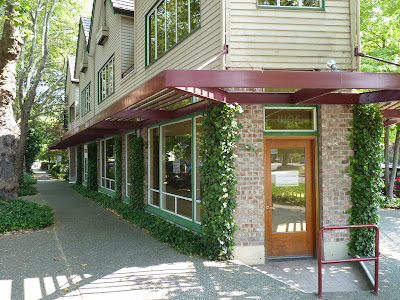
Though the landlord was less than forthcoming on the subject (at least to us), Key Bank proudly confirmed this week that it’s all true: the Bank is coming to Madison Park. It has signed a long-term lease and will be moving into the first-floor spaces previously occupied by Ropa Bella and two other tenants at 4105 E. Madison Street. There will be a lot of remodeling necessary to accommodate the new “specially designed” 3,200 sq. ft. branch, meaning that the opening won’t occur until February of next year. The ETA is actually Valentine’s Day.

Well this is exciting. A fourth bank for the neighborhood. If anyone thinks that the Park is already a bit overbanked, it’s pretty clear that's not an assessment shared by Key Bank’s decision makers. This is what the Bank has to say about it in a press release that we and the Madison Park Times received on Wednesday: “Madison Park is a growing and thriving place to live, dine and shop—and we’re thrilled to be part of its future.” That’s the word, at least, from the Bank’s District Retail Leader, John Roehm, who adds that “Key looks forward to being a good neighbor in Madison Park.” This is potentially good news for the neighborhood, since the Bank points out in its announcement that last year it gave over $1.6 million in cash and in-kind services to various Washington communities. I expect that the local business association and community council, among others, will have some “good neighbor” philanthropic opportunities to discuss with Key’s new branch manager when he or she arrives.

So why does Madison Park rate so highly as the location for Key Bank’s 159th branch in Washington? After all, there’s already an easily-accessed First Hill Key Bank branch on Madison Street that doesn’t seem that far away. Do you suppose it’s simply that the Bank, in the words of the press release, is “investing in making banking easier by moving closer to where our customers live and work”? That’s an interesting statement, really, which leads to a logical question about where their branches usually are located. Apparently in places too far away from where their customers live or work. Anyway, I think what they’re driving at is a contrast to electronic banking. Building new branches is at variance with the idea that no one needs physical contact with a bank anymore. At most, an ATM machine. Key Bank disagrees.

Of course it could simply be that Madison Park is where the money is.

Our neighborhood, by the way, joins Anacortes, Kent, and the Maple Valley as target markets for Key’s branch-expansion program this year. Key Bank, based in Cleveland, Ohio, is one of the smaller of the big national players, not quite on a par with San Francisco-based Wells Fargo, North Carolina-based Bank of America, or New York-based JP Morgan Chase. Locally, Key Bank has its roots in the old Puget Sound Bank and Seattle Trust & Savings, both gobbled up by Key years ago during a period when all of the major locals were taken over by the national banks (except for WaMu--and we know what finally happened there.)

I was pretty sure that the managers of our three already-in-place neighborhood banks would be anxious to weigh in on this momentous development in local banking. So I made the rounds yesterday to accost them and get their take on the situation. Their on-the-record responses ran the full gamut from “no comment” to “I am not authorized to speak to the media.” (Well, I guess that elevates Madison Park Blogger into the realm of media—even though it was only one banker’s opinion). But somehow I just didn’t feel that I was getting the complete picture of how they really feel about the new competition. I suspect they don’t like it much but just are too polite to say so.

Other Madison Parkers, however, have voiced concern about the new bank on the block. These include members of the community council—at least some of whom are still agitated about that “too-big-and-too-bright” Chase sign down the street. These good folks are hoping that Key Bank will be more respectful of “neighborhood standards.”

We shall see.

[I suppose this is as good a point as any for me to disclose (to those who have not already read my profile) that I myself am a banker, though not on the retail side of the business. I do not, however, work for any of the banks profiled in this posting.]